Thursday, September 17, 2015

That's the Life for Me!

Traveler on the Hard

Poor Traveler sits up on stands in a dusty lot in Guaymas, Mexico, her decks covered in tarps, her running rigging tackle wrapped in foil, and her windows taped over with sun screens.  It's hot there at the Guaymas Seca boatyard where the lowest temperature at night is 85 degrees, too hot for us mere gringos.  I personally need LESS than 85 degrees in order to sleep at night.  The folks who live in Guaymas have concrete, block, and stucco structures shaded by trees.  The families move between the cool inner rooms in the heat of the day out to the fresh breezes found at the doorways in the afternoon. Then they move onto the porches or spill into the street as the cool of the night settles in.  In the darkness the kids play and the adults sit and enjoy the relief of the night airs.

Deer on the Mountain

Here on the mountain we do the same, opening up the windows at night when the outside temperature is finally cooler than the inside temperature.  Here in northern California it's chilly at midnight and roasting hot by noon.  The drill is: windows open at night, closed in the daytime.  Connie and I are staying in a house under construction.  Our sleeping room will someday be a nice large bathroom.  Right now it's simply a room with tiled floor and walls and unconnected pipes where the fixtures will eventually go.  The beautiful tile work keeps the room cool even when it is 95 degrees outside, great for napping. We like our room.

Bountiful Harvest

We are lucky to have such a place to spend a few summer months, a quiet place with deer, quail, and three sweet cats.   Our friends are building a guest house off the back side of the shop that presumably we could use for our sleeping quarters if we visit next year.  Digging holes for its foundation we found solid rock so we hauled a big compressor and a 90 pound jack hammer up the hill from town so we could break up the rock.  I took a one minute stint on the jack hammer just for fun and it totally kicked my butt.  Better a younger man than I for that job!
Scott Jack hammers

With the current three year drought some local wells have run dry and many people are getting their water tanks topped off by tanker trucks you can hear slowly grinding their way up the gravel roads in the mornings.  Fires are a constant hazard.  Two weeks ago a fire blew up east of here, coating the horizon with billowing smoke.  I set up my lawn chair where I could see across the valley and watched through binoculars the California Fire spotting planes circling then guiding the airborne tankers with their red-dyed, flame retardant drops.  The fire moved off to the north and was finally contained and doused.

Four days ago a fire far to the south of us blew up from 10,000 acres to 50,000 acres in one day, forcing evacuations in a 30 mile radius.  Local hotels are booked and farmers are boarding livestock for their neighbors across the county.  An entire small town burned to the ground.  My heart goes out to those who not only lost their homes but their jobs as small businesses went up in flames.

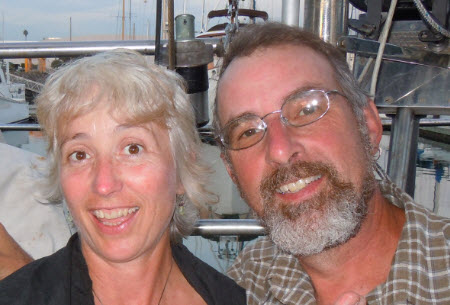
Ezrah, Michael, Connie, Tom

I've been researching various places where we might want to settle down once our sailboat cruising lust dies down. One of the reasons we left Puget Sound is because of the dark, wet, cold winters there.  In contrast, we found Mexico to be heaven in the winter time.  For sunny warm days and cool nights, northern California has a  perfect climate so we were starting to consider settling here but now, as we see the increased fire danger and water shortages, we're rethinking the suitability of this area for our little retirement ranchette.  As we look toward a warmer, dryer future perhaps we should place more importance on locating where there is an ample water supply and less risk of fire.  This brings us back to Puget Sound, the new sunny place in the Pacific Northwest.  Who knows? With the melting polar caps Connie's little Tumwater house might someday be oceanfront property!

Connie and Tesla
Yesterday we were remembering how nice it was to live on the boat, having our private little nest where we make our own schedule and decide fresh each morning what we'd like to do that day.  It's nice visiting with friends and family during the summer but we do miss our independence.  When you stay with someone, you live their life style.  You immerse yourself in the comings and goings of the house and subjugate your interests for theirs.  This is grand fun for a while, and we've been lucky to experience such a varied existence but after a while we find we yearn for more privacy and want to take back some control of our lives.


Both Connie and I love exploring the sea and the land, and we've become comfortable doing so, even feeling that when we are traveling we ARE at home. We decide which way to turn and how long to linger.  Connie's suggestion? Let's arrange it so we can live on the boat full time!  Come November we hope to get back to the boat and spend the winter in the warm Mexico waters.  Then we'll try for Hawaii again and end up in Puget Sound in the summer.  When autumn rolls around, instead of heading south, we'll find a place to tie the mooring lines and see what it's like to spend a nice warm and dry winter on the boat in Puget Sound.  Now that's the life for me!


Coming Back Alive


                                                             Copyright
Keith Dekker
Connie Bunyer 2011


This ship it has it's problems, the anchor’s made of wood.
It floats around up on the top, it doesn’t hold so good.
The sails are torn and tattered; they let the wind go through.
We lost the tiller yesterday, the charts and compass too.

The food is spoiled, the cooler stinks, I think I saw some mice.
The meat is gray, the cheese is green; when can we get more ice?
There is no fruit or veggies, the scurvy’l reappear.
The thing that really scares me most is we’re running out of beer.

Chorus:     We’re coming back alive, we’re coming back alive.
            Didn’t think we’d make it, looks like we’ll survive.
            When we get back to dry land, I’ll never go back to sea.
            I’ll walk on land that doesn’t move.
            Hey, that’s the life for me!

The cook he hates the captain, the captain hates the crew.
The first mate yells at everyone, especially me and you.
I might just jump, I'll swim away, get off this lousy boat.
The bosun tried it yesterday, he sank he didn’t float.

The dinghy sank last Friday, it was an awful sight.
It’s where we kept the Cuban rum, I must have cried all night.
The captain says, “Get over it!” he says, “We’ll do just fine.
We may still have some whiskey left and the bilge is full of wine!”

Chorus

If we get back I tell you, I’ll kiss that flat ol’ ground.
Shake hands with everybody, big hugs for every hound.
Then I’ll be movin’ inland yes, that’s the life for me,
Far from this old ocean and the Salish sea.

I heard the ship go bump last night; it was ‘bout 2 or 3.
I went outside to have a look; it was too dark to see.
First mate went out and came back; his shoes were full of sand.
I looked and yelled, “Holy cow! I think we’re close to land!”

Chorus

Once we made it back to dry land, it didn’t sit so well.
The traffic it was crazy, the weather hot as hell.
I really miss the water, yearn to be afloat.
So back we went double time and now live on this boat.

We’re comin’ back alive, we’re comin’ back alive.
Didn’t think we’d make it, looks like we’ll survive.
When we get back to the water, where the wind blows free,
I’ll sail on seas that always move.
Hey, that’s the life for me!


Thursday, July 30, 2015

The Bishop of Norwich

Hats off to John Vigor for this one.  See his July 19 post.

As the hands finish their evening repast it is the custom on Traveler and many other naval vessels to close the meal with a glass or two of ruby red port.  Traditionally, the decanter starts at the right hand of the host who pours himself a glass and passes the port to the left.  It then makes it way around the table in a clockwise direction as tradition dictates.  "Why clockwise?", you might ask. Some say this represents the passing of time, others say it frees up the sword hand for fighting.  Most likely it is only because most people are right handed and find it easier to pour with their right hand.   John claims it has roots in the Coriolis effect, that which makes high pressure weather systems cycle clockwise in the northern hemisphere.  He also claims we should pass the port counter-clockwise when we venture south of the equator but that is a matter of debate.  Sailors remember this clockwise tradition with the saying, "Port to port."


When at table, it is considered bad form to ask the neighbor to your right to "Please pass the port."  Instead, you can say, "Do you know the Bishop of Norwich?"  If he knows the tradition he will pass you the port.  If not he might say something like this, "No sir, I don't.  Why do you ask?" and your reply would be, "He is a terribly nice chap, but he always forgets to pass the port."

To get the decanter moving, you might also say something along the line of, "Do you have a current "pass... port?" while looking at the decanter.  But back to the Bishop....  The Bishop of Norwich (John Sheepshanks 1893 to 1910) was quite a drinker in his early years and was known to hog the port decanter through two fill ups before passing it to the left.  In his later years he'd developed the habit of nodding off at the table just as the port was making its rounds and so had to be prodded to pass the port.


At our table we have another tradition around the passing of the port, or the drinking of anything for that matter.  We toast. To propose a toast, just hold up your glass, make your statement, then while clinking your glass with all others at the table make eye contact with one and all. Sometimes, like the Bishop of Norwich, a non-eye-contact guest at the table must be nudged to look up. Once everyone has establish eye contact, then down the hatch it goes.  Proost! Cheers! Salute!

Popeye's Last Supper 


From Left to right - Alice the Goon, the Sea Hag, Poopdeck Pappy, Brutus, Professor O.G. Wattasnozzle, Olive Oyl, Popeye, the Jeep, J. Wellington Wimpy, Rough House the cook, Swee' Pea, George Geezil, Castor Oyl


Sunday, July 12, 2015

Seven Fires Across America

Esta Ton on Angel de La Garda
We left you last in May in Puerto Don Juan, way up the inside coast of Baja California Norte. Since then we've traveled thousand of miles, mostly on pavement.  I thought it was time to catch everyone up on our doings.

Leaving the calm waters of Puerto Don Juan behind we sailed Traveler over to the Bay of LA Village and anchored just  off the beach.  What followed was some provisioning and a nice little lunch/internet break at Guillermo's RV park, restaurant, and hotel.  After rowing  back out to the boat in a building sea we had a wonderful sail north to a little anchorage on the west coast of Isla Angel de La Guarda called Esta Ton.

I'd found the GPS coordinate for Esta Ton in one of my guides and was sure glad to have it as it's impossible to find with the naked eye when approaching from the west.  We tucked in there for the night and headed south in the morning, sailing slowly then motoring around the end of the Island for an anchorage at Isla Estanque, staying well away and upwind of the lagoon to avoid the swarms of bobos, little non-biting flying insects that swarm by the thousands.
Angel de La Garda and the Midriff Islands are in the northern Sea of Cortez

See some fantastic pictures of Angel de La Garda by photographer Blake Crosby  here.

We continued south the next morning and soon arrived at Isla Partida where we motored the dinghy out to the sea lion colony to watch hundreds of the stinky fat fellows frolic and bellow.
That evening, the bugs descended on us like a plague.  Bobos, mosquitos, gnats, everyone came to visit our little house on the water.  After many assassinations that left our walls and ceiling spattered with bug guts we finally got to bed, the caterwauling of millions of birds echoing off the cliffs making the place a spooky retreat.  We'd read about Isla Raza, the next island South as being a protected breeding ground for Heerman’s Gulls and presumed that's what we were hearing from our quiet anchorage.
Isla Raza

The next day we hopped down to Isla Raza and sailed in close to see that every square inch of shoreline was covered in birds.  Heerman's Gulls and Elegant Terns mobbed the place.  Staying upwind to avoid the guano stink we rounded the corner and made our way to the next island south, Isla Salsipuedes where we cautiously found our anchorage on the rocky west side of the narrow island.   We had a great  hike, loved the location, and vowed to return.  That evening we were attacked fiercely by the little flying demons and decided it was high time to get away from these bugs and high winds and head back over towards the mainland.
Isla Salsipuedes

The morning brought fresh northwest winds that freshened up even more as we galloped along sailing east out of Salsipuedes then just north of San Esteban.  By that time the seas were pretty rough and we wanted nothing more then to find someplace sheltered from the wind, waves and swell coming in on our port quarter.  The swift tide swept us north as we closed with the southern shore of Isla Tiburon so while we were making 6 knots over the water we were really crabbing northeast at about 4 knots or less on the GPS.  We finally found the anchorage of Bahia de Los Perros around the southeast corner of Isla Tiburon where we stayed for two nights, getting good shelter from the stiff northwest winds.  That layover day we took a nice long hike finding hundreds of Murex shells.  At the end of the beach on a little elevated point was a  little concrete memorial.  You see these everywhere in Mexico and they usually mark where someone died.  Inside this mini house we found some plastic flowers, a few little shells and tokens and a lit candle.  Yes, a lit candle.  Looking around we saw no boats in sight, no fishermen, no ghosts, no pangas, nada.  A little creepy.

Our whole cruise from Conception Bay north to the Bay of LA and across the Midriff Islands was marked by the absence of other power and sailing vessels.  Most of the time we had anchorages to ourselves and saw only occasional small fishing boats as we made our transits.

Leaving Tiburon, the last of the Midriff Islands, we headed towards Bahia Kino on a southerly hoping to find a little protection in the bay there from the south wind.  As the day progressed, the wind rotated around westerly then settled into a blasting northwest wind... again.  The waves built and as we approached Bahia Kino we realized there was no way we'd anchor in that shallow bay on a lee shore.  Reluctantly we beat our  way out of the shallow water and set a course south, veering away from the land to try to get more water under the keel.  What followed was a rough night, no sleep, and the problem of arriving at our preferred anchorage before the sun came up.  At 4:00 AM we changed our destination to Bahia San Pedro further down the coast and arrived there just at sunrise.

We "farmed" a huge ball of sea grass on the anchor on our first attempt in the bay.  After tediously pulling off the weed we joined the crowd just off the beach, got the anchor set well, ate a quick breakfast and went to bed, thus finishing up our solitary journeys in the the almost-northernmost Sea of Cortez. 

One night in Marina San Carlos and one night in Marina Fonatur Guaymas and the boat was clean enough to haul out at Marina Seca Guaymas, our old familiar yard.  The same day we hauled out we caught the Tufesa night bus to Phoenix, arriving in the morning to buy a 1998 Oldsmobile mini van off of Craig's List.  A few days later, fully licensed and insured we drove back down to Guaymas and began to get the boat ready for the long hot summer.  This time, in order to keep our sanity in the 90 degree heat, we got a cheap hotel in town (Suites del Sol) with a working air conditioner.  We'd get up at 6:00 AM, drive to the yard, and work until about noon.  Then we'd run some errands and go back to crash in the hotel AC til 6:00 PM or so then go back to the yard to finish up a few projects before the sun went down and the mosquitoes came out.  Working this way we finished our tasks in three days flat!

Tasks:
Measure things and make lists of supplies needed from the states.
Remove center seats from mini van and stow inside boat cabin.
Build a bed in the back of the mini van.
Remove genoa and fold.
Remove main and fold.
Stow all sails below.
Remove the Bimini.
Remove running rigging or use messenger lines.
Wrap blocks, winches, clutches in tin foil.
Take fuel out of the outboard, and Honda generator.
Defrost, clean, refrigerator.
Empty water tanks, pull off inspection ports, clean thoroughly.
Remove all food from cabinets - give to guards or stow in the car.
Clean cabinets, put down boric acid.
Deflate dinghy and stow on cabin top.
Move clothing and camping gear to the car.
Wash and stow bedding in plastic bags.
Stow all cushions in plastic bags.
Stow all galley stuff in plastic bags.
Exercise thru hull valves and stuff them with green scrubbies.
Cover windows with foil.
Unplug power and water.
Disconnect house batteries.
Tarp front deck, lower mast, top deck, solar panels, and cockpit.
Tighten the jack stands under the boat.
Make our escape.

Escape:
One night in Phoenix with Eva, Brevin, Blake, Diane and Tom.
One night in a Motel 6 on I-40, what luxury!
Two nights with Barb in Albuquerque talking about right wing christian terrorists.
Two nights bandit camping in central Colorado.  Visit hot springs.
Three nights at Desiree and Damon's Cruiser's retreat in Palisade. Such sweet people.
Six more nights camping in national forests... Visit hot springs.
brought us to Mount Rainier National Park in Washington state and a wonderful, end-of-trip hike.


When we camped, we would find a forest service road, usually gravel or dirt and we'd go a mile or so off the pavement until we found a turnout and a fire pit.  These encampments are everywhere in National Forest or BLM lands.  We'd ALWAYS make a fire and heat up a little dinner on the camp stove.  Connie would play some music and we'd share a bottle of wine before going to bed in the back of the mini van.  Quiet, peaceful.. nice.

Another guiding aspect of our road trip was the search for hot springs.  We'd stop at a library or coffee shop and use the laptop to find hot springs near our route, then try to visit them later in the day.

By the time we got to Washington state the burn ban was on.  Luckily for us we were home by then.

Gosh how I enjoy the fires.  Connie too.  I didn't realize what a firebug she is, but get a fire going, put a stick in her hand and she's at it poking and rearranging to perfection.  We experimented with various methods of building the fire.  We'd gather the wood, stack it in little piles by size, then create the base and the structure.  Connie prefers the crisscross method and I mostly used the teepee model.  Over our seven glorious nights of fires I adopted Connie's crisscross method as the best on the planet.

I know that when contrasted with the larger issues effecting your life here in the modern times talking about the different methods of building a fire might not seem very important.  Connie and I are leading more simpler (though sometimes more complex) lives so the mundane can take on great importance for us.  KISS!
Sort wood by size

Stack in crisscross design

One match if the wood is dry

Teepee method. 


We arrived in Olympia smelling like bums.

One of the many Michaels that we know loaned us his Oly apartment for the summer so we settled in there, washed our dirty bodies, clothing, and car and set about finding me a wardrobe for when I go back to Harborview Med Center to do some hourly work through July. Connie's enjoying spending time with her kids and weeding the garden beds at her rental house.  On the weekends I'm taking Amtrak from Seattle to Olympia to re-consummate my marriage and during the week I stay with Seattle friends, do the standard bus commute, and clock my eight hours catching up on open work tickets with the HMC Finance IT team.

So that's what we've been up to, the standard stuff that we do every summer for the last three summers.  Jim Kitchen at Puget Sound Sails is making us a new main sail. We are ordering new isinglass for the dodger, giving the sewing machine a tune up, researching how to mend or replace a steel diesel tank, and talking to Scott and Karen about another attempt next spring to visit Hawaii.  What?  Yes, we are thinking about attempting Hawaii again.  Sounds like a mountaineer saying, "Yep, we're thinking about attempting Kilimanjaro again this season.

Life is so different here (in the states).  It ain't Mexico.  Here you have clean sidewalks, smooth roads, nice parks, and big trees!  I was very happy to be back in the States and enjoyed our cross country trip immensely .  Then at the end of the trip in Seattle there was that first morning when I walked up the hill to work.  As I walked my nose was accosted by smells of stale tobacco smoke, diesel, urine, and believe it or not, rats. Yes, I can smell rat pee and poop wafting up from the basements of old buildings.  The city air is filled with sirens. Most everyone is really white and they constantly stare at little flat electronic devices.  Catch someone's eye and smile and you get a little shy grin or a quick cut to the side.  People drive fast and talk loud.  Look, what's that? Some campers, right here in the city.  There are tents pitched on the sloping ground next to the freeway overpasses. Those guys look a little scruffy, huddled in small groups smoking cigarettes.  No glorious fires for these folks!  Would they use the crisscross or teepee method?

Thanks for listening. Now get out of here and do something worthwhile with yourself!