Saturday, March 26, 2016

Counting Flowers on the Wall

Counting flowers on the wall, that don't bother me at all. Playing Solitaire till dawn, with a deck of fifty-one.   1965 Statler Brothers

We've got all the time in the world.  Seems like ever since I started this blog I've had a backlog of things to do.  Keeping this boat running has been a full time job.  Until now, that is.  I wake up in the morning, slowly, amble over to the nav station with my cup of tea and take a look at the "to do" list.  Nope, nope, done, waiting on a part, nope, done, decided not to do, not necessary.... end of list.  How can that be?

Many folks think this cruising life is nothing but sitting back in the cockpit with a cold beer in hand, watching the pelicans dive into the blue sea.  That's not true.  I sit in the cockpit with a cool beer in hand watching the cormorants soar, counting the number of boats anchored here in the bay.  Occasionally I'll grab the binoculars to watch an incoming boat lowering their mainsail as they make their approach. Right now the sailing vessel Passing Wind is circling around looking for the right spot to drop their anchor.
Little dock way up the lagoon on the river tour.

Passing Wind came to a complete stop before dropping the hook.  They get an extra point for that.  Then they backed down slowly, letting out more rode.  Another point.  But then the bow fell off and she ended up stern to the wind.  No points deducted.  That happens to me once in a while when there is a stiff wind.  Now that the anchor is set it looks to me like that they didn't let out enough chain.  In addition they are only about 200 feet off our starboard side.  This is too close considering how large this bay is. Now some boaters would just go stand on their deck and assume an "in charge" stance, hands on hips, scowl on face.  Others would yell across the water, "You are tooooo cloooose!"

Not so for Traveler.  Our game plan, since we are going to visit another boat for dinner tonight, is to stop by on the way to visit with Passing Wind.  We will make sure to approach from the windward side.  After the pleasantries are over with, I'll assign them the task of looking out for Traveler in case our two boats decide to get too cozy when the wind drops and the current starts pushing everyone in different directions.

There are 28 boats in the bay here in Tenacatita this afternoon.  We had a brisk wind most of the afternoon but it is calming down now.  Yesterday we took the dinghy into the beach and had a walk followed by some beers at La Vena, the little palapa restaurant.  We met some other boaters and talked about having a dinghy raft up tomorrow, Friday.  We made the announcement on the morning net and will mention it again tomorrow morning.  Then at 5:00 PM Connie and I will take the dinghy over near Good Dog Beach and drop a little anchor tied to a float.  As other dinks come around, I'll take their bow line and tie it to the anchor float. Hopefully we'll get everyone in a circle.  I'll say a few words then get everyone to introduce themselves.  Our new friend Armando is getting a nice little story together so he'll have his own speaking slot.  Then Connie will play everyone a few songs while they pass around the appetizers and the old books they are trying to get rid of.

Since Robert (the Mayor of Tenacatita) and his lovely wife, Virginia, are not here to run the event, we have started arranging the Friday afternoon raft ups.  As I'm not the speaker that Robert is, we just keep it casual and let everyone chat up their neighbors until the bugs start biting.  Then the circle breaks up and everyone putt putts away trying to find their boat.

Friday night raft up!
The river tour up the estuary in Tenacatita has been made easier by locals and cruisers with chainsaws and machetes so now Pangeros can take tourists all the way up the river to the little lagoon.  It's easy  for cruisers to take their little motorized dinghies on the tour.  Come in on the high tide and return on the ebb.

The beers are cold at the palapa restaurants.  In Barra de Navidad the marina pool is wonderful, the local music is good, and the French Baker still makes his morning runs bringing fresh croissants and pastries. Life is pretty easy here.

Traveler will start to migrate north in a week or so.  We'll take it slowly.  Wouldn't want to work up a sweat, don't you know?

Last fall, hurricane Patricio pushed the bulk carrier Los Llanitos aground near Barra de Navidad


Sunday, February 28, 2016

Isla Isabel to Tenacatita February 2016

Isla Isabel
We just finished up dinner and are listening to Radio Havana on the single side band radio.  That’s frequency 5997.0 on the AM band.  There is a swell coming in from the south and it’s tossing us about a little bit so we have to keep an eye out on where we set our plates and glasses down here in the cabin.  The other night we had nine guests aboard with guitars, mandolins, a ukulele and some percussion instruments.  In the middle of a nice little jam we got tossed by a southerly roller and a whole bottle of wine crashed to the floor.  Now we have wine in the bilge. 

Blue Footed Booby
We arrived at Isla Isabel on Sunday Feb 21st after a bouncy 42 hour crossing from Los Frailes on the southeast corner of the Baja peninsula.  We left at 09:30 and motored through calm seas until mid- afternoon when the breeze picked up and we were able to sail with the genoa and full main.  This continued until midnight when I had to turn on the engine, furl the jib, and flake down the mainsail which was flopping around like crazy.  With our new sails we just hate to see them flopping against the rigging --when that happens we pull them down. 

We were sailing along with another boat named Mandolina with Rich, Thomas, and Bradley (AKA Stanley) aboard.  Rich plays Mandolin and guitar. Thomas plays guitar.  Bradley had a very long beard. In fact, all three of Mandolina’s crew sport beards.
Bradley (AKA Stanley)
Rich and Thomas had put ashore a crew member in Lapaz and wanted another.  So they went to the local hostel there in LaPaz and found a young man staying there who was motorcycling down the Baja.  They shanghaied him aboard to fill out the watch schedule.  Now Bradley (AKA Stanley) is hooked on the sailing life and his motorcycle sits lonely waiting in LaPaz.
Bradley's almost brother Thomas

We followed old Mandolina across the Sea of Cortez, rocking and rolling with a 4 foot swell at 3 seconds, very uncomfortable.  Two days and two nights found us approaching Isla Isabel, a small island 40 miles off the Mexico coast, 216 miles from the Baja cape.

We came in just after dawn and found anchorage on the east side next to the two Mona’s, fantastic rock pinnacles jutting up out of the sea.  Big breakfast…. then we crashed, down and down into deep sleep being pretty deprived after 46 hours in bouncy seas.
Lumpy seas don't look so lumpy here but believe me, they are sleep killers

The next day we got a call from Mandolna saying that the big Morgan was pulling up her anchor and there would be room for us in the southern anchorage.  The trouble was, our anchor chain was wrapped around a big rock.  The water was so very clear we could see the chain and the rock so we were able to maneuver Traveler this way and that to free the chain and get the Bruce anchor aboard.  Once over at the southern anchorage Thomas was in the water with his snorkel and fins and he swam us to our anchor spot, finding a little sand patch where the anchor would set.  Valet parking!  Connie dropped the anchor, Thomas checked it, and I backed down on ground tackle, engine in reverse.  Thomas popped back up saying, “She’s dug in!” 
Rich, Scott, Connie with frigate birds

Later that afternoon there was talk on the radio between the various boats about the need to get together to play some music as there happened to be four musicians anchored around the island.  Being the party boat, we invited everyone over.  With the table down we can sit seven or eight people down below.  It was a fun evening.

Isla Isabel is a wonderful and strange place.  It is far enough from the mainland to not get much boat traffic.  Cruisers use it as a halfway stop between Mazatlan and Puerto Vallarta.  It’s a protected island and a nesting ground for frigates and boobys.  Frigates normally don’t land. They just soar.  This place is unique in that has a fresh water source for the birds and there are no predators.  So the frigates will land, make nests, and hatch their young.  The short trees on the island are full of nesting birds, often a half dozen per tree.  Up the ridge from the bay the blue footed boobies nest, many of them nesting right on the ground. On the hike around the island you have to watch your step so as to not tread on a sitting boobie.  Iguanas roam the warm rocks and crabs swarm the tidal areas.  It is an amazing place, the Galapagos of the Mexico coast.
Water Ballet

There are two anchorages, both only suitable in moderate weather.  The southern anchorage is a small bay with reefs on both entrance sides.  This is where the dingy landing beach is and also the access for the research pangas from the mainland.  With a swell running it can get quite turbulent as the water surges over the blocky reefs.  We found that three boats can fit in here with 100 feet of rode in 30 feet of water depth.  On the east side of the island the two Monas protect another anchorage where three or four boats can find a sandy patch to set the anchor into.  The east anchorage is more exposed to the north wind but has more room to maneuver and a quick exit route if the weather turns; quick, that is, unless your anchor is fouled.
Booby mom and chick

With walking trails around the island, plenty of close-up wild life viewing, snorkeling, fishing and whale watching, this place is a wonderland.  So if you ever happen to pass this way and the seas are fairly calm, come visit Isla Isabel.  Just watch out for the wine bottle.

After leaving Isla Isabel, we crossed to the mainland 55 miles to the southeast to another beautiful anchorage, Chacala. Being out of fruit, milk, eggs, tortillas, bread, and beer it was time to provision.  There are couple of small tiendas in Chacala for the groceries and a cooperative fisherman’s shop where we bought some fresh barracuda.

Moonrise Isla Isabel
Another day’s run brought us to Punta de Mita on the northwest corner of Bandaras Bay.  Then the next morning we headed south around Cabo Corrientes into rough water again.  We motored then sailed into the night until our speed fell to 2.5 knots.  We motored again and arrived in Tenacatita by noon the following day.  Lots of motoring  lately, 100 hours of it since we left Guaymas 17 days ago.
Ava and Brevin, our dolphin friends


Tenacatita is about as far south as we’ll get this season.  Barra de Navidad is just around the corner, another of our favorite places.  Anyone wanting to come down and visit should contact us via email. You would fly into Manzanillo airport then taxi over to Barra where we'd pick you up in town. No kidding.  It's as simple as that.  Of course, the flight's gonna cost you an arm and a leg.  Oh wait.  Radio Havana is playing a Cumbia.  Connie, let's dance!


Sunday, January 17, 2016

Diesel Tank Replacement - The Details, Ad Nauseam

The mastermind behind the scenes
Note:  This is a long, tedious post. Quit now while you are still awake. 

In a previous post you read how we started our Pacific crossing last year only to have our transit cut short by a leaking diesel tank 120 miles offshore.  We turned around and limped back into the Sea of Cortez. Then months later, in the yard, we removed those bad black iron tanks. Now, eight months later, we are in the process of replacing those two rusty, black iron fuel tanks with new HDPE plastic ones.

I was concerned that the old tanks would be difficult to extract from under the cockpit but after disconnecting the copper supply and return lines, the filler hoses, the vents, and the miscellaneous fasteners holding the tanks in place, I found that Stan Huntingford, the designer, had made it possible for the old tanks to slide, one at a time, through an access door into the aft cabin.  As described in that previous post, we did get them out without incident, and by "we", I mean Omar and his brother Arturo.    We felt pretty good. Here we were, one week in Mexico and the old tanks were out of the boat.
Albert Kelttke and Scott Voltz

A fellow sailor here in the yard went to a marina swap meet in San Carlos and came back telling me about this guy who was making HDPE plastic tanks.  Albert Kelttke is the guy's name and sure enough, he was willing to help me.  Using the old tanks as templates, Albert made up two new tanks out of plastic, making them two inches shorter to help ease the installation.  With two weekends and some holidays, it was eleven days to receive the new tanks.
See how the two tanks come together to fit the shape of the hull?

I visited Aldo at Hidraulicas del Pacifico who hooked me up with all the necessary hoses and valves.  I showed him an idea for creating the pickup tubes from copper pipe and a bronze plug.  After rummaging around in his shop, he came up with the necessary items, then said, "I can make these up here if you want."  A half hour later I had my pickup and return tubes created and in my hand.  I love Mexico.  Anything is possible.
Connie cutting the copper pickup tube to length

Day two after getting my new tanks delivered, Connie and I hoisted the two tanks up into the cockpit using the main halyard and a turning block.  Thinking about the orientation of the starboard tank, we dropped the skinny end down the companionway and stood the tank on its end.  Then with the aft cabin door removed we could just manage to squeeze it through the doorway and rotate it 90 degrees. 
When she wasn't busy sewing new glass in the dodger she wrangled tanks.
We lifted and pushed it through the access door and lowered it, leaving the front end protruding into the cabin.  This left me room to insert the 27 inch fuel pickup tubes before we pushed the whole thing into the empty space.  After wrestling it into the "under cockpit" I tied a few lines to it and hoisted it up and out to starboard, getting it out of the way so the second tank could come along side.
New HDPE tank / old black iron tank

Day two after getting my new tanks delivered, we brought the second tank in the same way but got it backwards so had to bring it back out into the cabin to turn it around.  After some swearing we got the second tank in, and spent some time shoving the two around; a little frustrated about how they fit in the space.  I called Albert as I was worried that the tanks would not be supported very well in the center and he suggested that I pull them out and create better support. I pulled out the port tank, crushing the fuel supply copper fitting in the process.  Darn!
Tanks in place. Note the copper fittings along the front edge.

Day three, I measured and cut some plywood and furring strips, making some supports that would lie in the deepest part of the vee in the hull, painting them with resin so they'd last. These also provided a channel for three control cables and one bilge pump hose to transit freely under the tanks.  When we put the port tank in again (with a repaired fuel supply fitting) and let the starboard tank come to the center, it all lined up and seemed to be supported pretty well.  Whew!  What a relief.
Blocking on the front prevents tanks from moving forward or to the side.

When you have 850 pounds of fuel aboard and the boat is leaping about like a bucking bronco you want that 850 pounds to stay in place.  My next job was to secure the tanks to the boat.  I spent the first day blocking in the front of the tanks.  I built up wood pads between the bulkhead and the front of the tanks so they could not move forward,  then added some blocking to prevent the front from moving to port or starboard and more blocking to prevent the front from moving vertically.  After all, we could be in a knockdown situation and not want 850 pounds of fuel busting loose when we were already dealing with being upside down, floorboards flying through the air, and frying pans crashing about like missiles.
Blocking in the rear.  Note the breather hose. The big hose is for the cockpit drain.

Day four, post tank insertion, I secured the rear of the two tanks in much the same way as the front.  By this time I was becoming "one with the bilge."  My legs got used to being curled under me.  My arms got used to being extended forward with little body support.  My abdominal muscles were getting a workout.  At the end of each day I was totally wasted.  For some reason I was gaining weight.  Hmmm.  Working hard... gaining weight.  Makes no sense.

Day five I secured the middle of the tank.  Day six I ran the vent hoses from the back of the tanks to the little vent inconveniently located behind the autopilot and engine controls and I connected the two 1.5 inch filler hoses to their deck filler caps labeled "Diesel Only."  To get the stiff hoses onto the nipples I boiled them in water so they'd slip on more easily.  Then I had a hose clamp party, double clamping everything and everybody in sight.

On a roll now, day seven... I ran  the supply hoses, drilling holes through bulkheads where needed and  using plastic fasteners to keep the four hoses from moving about.  On day eight I ran the return hoses. Running out of hose, I ran back to Hidraulicas del Pacifico to pick up more supplies.  Day nine I mounted the two way valves and the two water separator/fuel filters and connected whatever was not connected.

Originally the boat was equipped with two separate fuel supply lines that led to one Racor filter.  However, the two fuel tanks were also connected together with a big 1.5 inch hose so why the two separate supply lines?  Didn't make sense.  This time I kept the two tanks totally separate.  They both have their own pickup tubes and water separator/filters.  From there the fuel goes to a two way valve so I can switch from one tank to another.  Also, the fuel return from the engine has a two way valve so I can direct the returning fuel to the tank I'm drawing from.  You don't want to draw fuel from one tank and return to another.  I read somewhere that the volume of fuel being returned to the tank can be up to five times more than the fuel being used by the engine. So if you pull from one tank and return to another you just might find out you are flooding one tank to the extreme.  Who'd a thought that?  Experienced mariners no doubt.
These are the parts we bought at Hidraulicas del Pacifico. 
On the fuel return I have a tube so that the fuel exits at the bottom of the tank instead of just falling in from a fitting on the top.  I read somewhere that splashing diesel introduces air into the fuel.  Maybe this is bunk.  But a handy option here is that if I have a problem with the pickup tube I can easily reroute that supply line to the return and it will work as well.

The good thing about all this fuel running about is that it is going through a filter each time.  It's kinda like having aboard a fuel polishing system, removing any moisture and all that little grit.  Don't you want shiny fuel?  I do.

Day ten, I took my diesel jugs to the Pemex station.  I started with four jugs and twenty gallons.  My neighbor Ken on Island Wind gave me a tip on how to get diesel from the jug to the tank.  Usually I use a pour spout and a funnel and make a big mess.  This time I took a three foot hose and put one end in the jug and one end down into the tank.  Then I took a second short hose and put it into the jug alongside the other.  I wrapped a rag around the hoses, sealing the opening pretty well air tight.  Then I blew into hose #2.  This created pressure in the jug, forcing fuel up and out of hose #1, which started the siphon action.  I kicked back and watched the diesel siphon into the tank.
Scott blows

Of course, I had to make a little mess.  I set the jug cap on the raw teak cockpit seat and made a diesel stain.  The Admiral admonished me... in a sweet way.

Day eleven, having assembled 15 meters of hose, two water separators and two valves, I realized that there was a lot of air in those lines.  I figured that by using the little finger triggered pump thing on the Beta engine, it would take about ten hours for me to hand prime the system.   My fingers aren't what they used to be so I started thinking about adding a priming pump.

Bill (a guy who is parting out his boat) had an old electric fuel pump.  Better yet, the pump was plumbed with a bypass hose so you could turn it on to get her going, then once the engine started to draw on her own, you can bypass the pump then turn it off.  I struck a deal to buy Bill's pump then set about finding a place to mount it.  This entailed another trip on day twelve to Hidraulicas del Pacifico for more hose and fittings.  While I was there I showed Aldo a rusted seacock handle I was trying to replace.  He could sell me the handle but it came with a brand new seacock :), so I declined.  "Let me have that thing." he said.  Ten minutes later he handed me the seacock handle, the rust ground off and a layer of Rust-Oleum paint applied.  No charge.  "Go, my friend, and next time you can  buy a new seacock."  I'll still be looking for a new handle but I thought that was very nice of Aldo, and typical of the way people do things in Mexico.  If you can make it work, do so.
Connie has a love/hate relationship with the sewing machine

Now my improved system is such:  Each tank has a pickup tube connecting to a hose leading to a dedicated fuel/water separator.  From there it goes to a Y valve so I can select which tank to draw from.  From the Y valve we go to an electric fuel pump that can we switched on or off with a bypass to use when switched off.  From there we go to the engine pre-filter, the mechanical fuel pump, then the main injector pump.  

Day thirteen, after wiring the fuel priming pump with an easily accessed switch in the engine compartment, I opened the valve for the starboard tank, turned on the fuel pump,  and started pumping diesel through the lines  and filter.  I had disconnected the hose to the engine and took it to a jerry can so as to contain the mess.  As I waited expectantly for fuel to come out of the open hose, the fuel pump stopped.
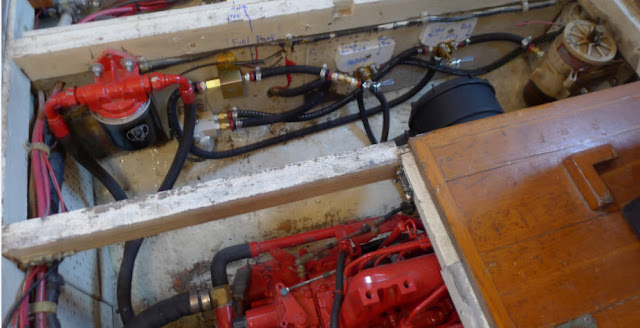
Oil filter, port side water separator, lift pump, Y valve for return, Y valve for supply, starboard side water separator

I checked power to the pump: 13.3 volts.  I disconnected the fuel In line and the fuel Out line.  No dice.  I removed the pump, carried it back to a battery, and wired it directly.  No go.  Dead pump.

Two days later I had a brand new fuel pump wired and plumbed.  Bill got his old pump back. 
Wonderful, new Isinglass for the dodger

Day fifteen now, this time the pump did its job filling the starboard lines then the port lines.  I let the pump run for a while, moving a couple of gallons of diesel through the system.  After connecting the engine supply hose, I got out the Beta manual to see how to prime the engine.  Loosening the fuel bleed screw on top of the engine fuel filter I heard a little sputter and watched fuel slowly run down the side of the filter.  After re-tightening the bleed screw, I opened up the bleed knob on the injector pump and let the electric fuel pump run for another half minute. 

It's go time!


Clear view!
We brought the garden hose into the engine compartment and shoved it into the salt water strainer.  Connie went up top and hit the starter.  Nothing.  I switched the battery switch from Off to Starter Battery.  Connie hit the starter again and the engine jumped instantly to life.  We ran her at various RPMs, moving the fuel selector from the starboard tank to the port tank.  No fuel leaks visible. Engine running fine.  High fives ensued.


Connie had just finished the dodger Isinglass replacement project from hell and I had finished the iron tank replacement project from hell.  Man, oh  man, it feels good to have these two difficult tasks completed.  The end is in sight.  We'll see water again soon!


On day sixteen I put this blog entry together.  That's a week to get the tanks out, eleven days to new tank delivery, and fifteen days installing.  That's thirty three days.  How is it that six weeks have gone by since I started this project?  All I can say is TIM-This Is Mexico!
   
This is how many beer cans it takes to do a diesel tank replacement.


Next post.... find out what Connie made from this triangle mess of foam pieces.

Tuesday, December 15, 2015

Home At Last

Being back in the Guaymas boatyard is like being back home.  We rolled in at sunset, finding our friends Desiree and Damon (S/V Gaia) sitting under their boat, holding court with a bottle of tequila.  Desiree ran to our car and gave us hugs through the window.  "Come over and tell us where you've been!"

We took more than a week driving from Olympia to Guaymas.  On the Oregon coast we found Heather on couchsurfing.com and enjoyed a nice evening with her and Gail.  In northern California we took a hotel room for the night then rushed down to Culver City near Santa Monica to Naida's house.  Naida and Marco (S/V Linda Rae) have a house a few miles from the marina and we stayed there for four nights catching our breath and getting all the measurements we needed to order a new forestay and roller furler.  Andrew, the yard manager down at Marina Guaymas Seca, climbed aboard our boat and measured things on the foredeck and sent them to us via email.  We then talked to Ed at Downwind Marine in San Diego and he said, "Come get your furler."

In San Diego we visited Ed and bought cabling and furler parts then visited with our friends Hal and Nina (S/V Luna Sea).  We stayed at the famous Vagabond Inn there in Shelter Island.  After speed shopping for all those items we cannot find in Mexico we high tailed it across the southern California hill country and the Arizona desert and found a Motel 6 just north of Tucson.

Dunes in the Arizona Desert


We drove across the Nogales border crossing and got the red light at the Mexico customs station.  I think we got flagged because of the weight of the car.  The customs agent poked around our belongings in a desultory manner until we volunteered to show her our wine.  This she examined with gusto, checking the volumes and making certain we were under our limit.  The five thousand dollars' worth of boat parts we were carrying remained undisturbed with no duty paid.

With a sigh of relief we left the crossing and wove our way to the Immigration office at KM 21 where we picked up our six month's visas.  Heading south towards Hermosillo, Connie and I whooped and hollered.  Home at last!


The first night we slept in the car.  Day two we unpacked a few things, cleaned up the galley, and prepared our cabin so we could have a clean place to sleep.  Now, a week later, we are in the work groove, cleaning the dust and grit outside and inside the boat, stowing our gear and provisions, and starting in on the big to-do list.  Even though we've got loads of things to get done, we are taking our time, enjoying hot tea in bed in the morning, and knocking off to watch the sun set each night.  I can't tell you how happy we are to be back home at the boat.  It is where we should be all year long.


Eggplant with a nose.


Being a boat, Traveler has a little evil streak that I'm sure you have noticed.  This time she pulled a little stunt by completely discharging all three of the main batteries.  Even though they were disconnected all summer, every one of them registered below 12.2 volts..... meaning, they were damaged if not dead.  One registered 7 volts, one 12.1 volts, and one 12.2 volts.  I cranked up the charger hoping for a miracle but after two days I gave it up and found a Bob in San Carlos who brought me two new 8Ds, and one Group 27 battery.  It cost an arm and a leg and would have cost my first born child if I had one.  We got delivery and hoisted those fat boys aboard.  So as not to feel too bad about the unplanned expense, my plan is to sell the Oldsmobile van to pay for the batteries.

Then I started in on the first big project, replacing the two black iron diesel tanks.  (As you remember, last April when we tried to cross to Hawaii, one of the tanks developed a crack and we had to turn back.)  I took everything out of the two cockpit lockers and the rear lazarette and disassembled the wood partitioning walls inside.  Then I removed all the vents and fuel connections to the two tanks.  The tanks were lightly tabbed with fiberglass to the hull so I used a chisel to break through the material on both sides.  After removing the rusted connecting bolts the two tanks were free.


Tank halfway out.  It just fits thru the access door.


I took the main halyard and ran it through a turning block at the end of the boom and down through the starboard cockpit locker, tied it to the starboard tank,and  hoisted it up six inches out of the way.  Then I was able to lever the port side tank to line up with the access door in our main cabin.  Rigging a lift line and a handle I pulled upward and was barely able to budge the tank.  Clearly what was needed now was some real manpower, younger and stronger than me.

I called Omar.  You remember Omar.  He's the gentleman who became part of our family last year as we spent three months together trying to get our new engine installed.  Omar said he'd be right over.

"Right over" means later the next day when Omar showed up with his brother Arturo.  The two of them heaved and shoved but the tank seemed to be stuck.  Connie got down in the port side locker, braced herself against the hull, and gave the tank a mighty shove.  It popped over a few inches allowing the men to lift the heavy iron tank up and out of the deep bilge, into the aft stateroom, up the stairs, and into the cockpit.  When I suggested we rig a hoist to lower it to the ground, Omar said, "No. We'll just throw it over the rail.  It will feel good!"


Omar and Arturo tossing a tank.


So Omar and Arturo heaved it over the lifelines and tossed it overboard where it crashed to the ground in a puff of dirt and dust.  Big grins all around.  Everyone in the yard turned their heads.  Applause broke out.  Then the brothers muscled out the second tank and tossed it overboard as well.

Albert, the local HDPE, PP & ABS welder came to the yard, measured the tanks, and is now building me new plastic ones in his San Carlos shop.  Meanwhile I'm cleaning the cavernous bilge and getting my ducks in a row to install new tanks, hoses, valves, and fuel/water separators.
On our checklist is exercising the thru hull valves. We try to do this every month while on the boat.  Of thirteen, one was frozen, its handle twisting off when we tried to force it open.  Oh joy of joys!

Even with a somewhat daunting looking task list ahead of us, we are still very happy to be back on our dear Traveler.  Late in the day when I walk through the yard and the guys sitting under a nearby boat holler over at me, I change course and join them for a beer or two.  We sit in the shade, a motley group of grey haired men, telling sailing stories, and discussing the various repairs we are immersed in.  If I listen closely I can just make out the distant sound of singing and playing as Connie down below on Traveler is composing a new song. A good life it is.


Thursday, September 17, 2015

That's the Life for Me!

Traveler on the Hard

Poor Traveler sits up on stands in a dusty lot in Guaymas, Mexico, her decks covered in tarps, her running rigging tackle wrapped in foil, and her windows taped over with sun screens.  It's hot there at the Guaymas Seca boatyard where the lowest temperature at night is 85 degrees, too hot for us mere gringos.  I personally need LESS than 85 degrees in order to sleep at night.  The folks who live in Guaymas have concrete, block, and stucco structures shaded by trees.  The families move between the cool inner rooms in the heat of the day out to the fresh breezes found at the doorways in the afternoon. Then they move onto the porches or spill into the street as the cool of the night settles in.  In the darkness the kids play and the adults sit and enjoy the relief of the night airs.

Deer on the Mountain

Here on the mountain we do the same, opening up the windows at night when the outside temperature is finally cooler than the inside temperature.  Here in northern California it's chilly at midnight and roasting hot by noon.  The drill is: windows open at night, closed in the daytime.  Connie and I are staying in a house under construction.  Our sleeping room will someday be a nice large bathroom.  Right now it's simply a room with tiled floor and walls and unconnected pipes where the fixtures will eventually go.  The beautiful tile work keeps the room cool even when it is 95 degrees outside, great for napping. We like our room.

Bountiful Harvest

We are lucky to have such a place to spend a few summer months, a quiet place with deer, quail, and three sweet cats.   Our friends are building a guest house off the back side of the shop that presumably we could use for our sleeping quarters if we visit next year.  Digging holes for its foundation we found solid rock so we hauled a big compressor and a 90 pound jack hammer up the hill from town so we could break up the rock.  I took a one minute stint on the jack hammer just for fun and it totally kicked my butt.  Better a younger man than I for that job!
Scott Jack hammers

With the current three year drought some local wells have run dry and many people are getting their water tanks topped off by tanker trucks you can hear slowly grinding their way up the gravel roads in the mornings.  Fires are a constant hazard.  Two weeks ago a fire blew up east of here, coating the horizon with billowing smoke.  I set up my lawn chair where I could see across the valley and watched through binoculars the California Fire spotting planes circling then guiding the airborne tankers with their red-dyed, flame retardant drops.  The fire moved off to the north and was finally contained and doused.

Four days ago a fire far to the south of us blew up from 10,000 acres to 50,000 acres in one day, forcing evacuations in a 30 mile radius.  Local hotels are booked and farmers are boarding livestock for their neighbors across the county.  An entire small town burned to the ground.  My heart goes out to those who not only lost their homes but their jobs as small businesses went up in flames.

Ezrah, Michael, Connie, Tom

I've been researching various places where we might want to settle down once our sailboat cruising lust dies down. One of the reasons we left Puget Sound is because of the dark, wet, cold winters there.  In contrast, we found Mexico to be heaven in the winter time.  For sunny warm days and cool nights, northern California has a  perfect climate so we were starting to consider settling here but now, as we see the increased fire danger and water shortages, we're rethinking the suitability of this area for our little retirement ranchette.  As we look toward a warmer, dryer future perhaps we should place more importance on locating where there is an ample water supply and less risk of fire.  This brings us back to Puget Sound, the new sunny place in the Pacific Northwest.  Who knows? With the melting polar caps Connie's little Tumwater house might someday be oceanfront property!

Connie and Tesla
Yesterday we were remembering how nice it was to live on the boat, having our private little nest where we make our own schedule and decide fresh each morning what we'd like to do that day.  It's nice visiting with friends and family during the summer but we do miss our independence.  When you stay with someone, you live their life style.  You immerse yourself in the comings and goings of the house and subjugate your interests for theirs.  This is grand fun for a while, and we've been lucky to experience such a varied existence but after a while we find we yearn for more privacy and want to take back some control of our lives.


Both Connie and I love exploring the sea and the land, and we've become comfortable doing so, even feeling that when we are traveling we ARE at home. We decide which way to turn and how long to linger.  Connie's suggestion? Let's arrange it so we can live on the boat full time!  Come November we hope to get back to the boat and spend the winter in the warm Mexico waters.  Then we'll try for Hawaii again and end up in Puget Sound in the summer.  When autumn rolls around, instead of heading south, we'll find a place to tie the mooring lines and see what it's like to spend a nice warm and dry winter on the boat in Puget Sound.  Now that's the life for me!


Coming Back Alive


                                                             Copyright
Keith Dekker
Connie Bunyer 2011


This ship it has it's problems, the anchor’s made of wood.
It floats around up on the top, it doesn’t hold so good.
The sails are torn and tattered; they let the wind go through.
We lost the tiller yesterday, the charts and compass too.

The food is spoiled, the cooler stinks, I think I saw some mice.
The meat is gray, the cheese is green; when can we get more ice?
There is no fruit or veggies, the scurvy’l reappear.
The thing that really scares me most is we’re running out of beer.

Chorus:     We’re coming back alive, we’re coming back alive.
            Didn’t think we’d make it, looks like we’ll survive.
            When we get back to dry land, I’ll never go back to sea.
            I’ll walk on land that doesn’t move.
            Hey, that’s the life for me!

The cook he hates the captain, the captain hates the crew.
The first mate yells at everyone, especially me and you.
I might just jump, I'll swim away, get off this lousy boat.
The bosun tried it yesterday, he sank he didn’t float.

The dinghy sank last Friday, it was an awful sight.
It’s where we kept the Cuban rum, I must have cried all night.
The captain says, “Get over it!” he says, “We’ll do just fine.
We may still have some whiskey left and the bilge is full of wine!”

Chorus

If we get back I tell you, I’ll kiss that flat ol’ ground.
Shake hands with everybody, big hugs for every hound.
Then I’ll be movin’ inland yes, that’s the life for me,
Far from this old ocean and the Salish sea.

I heard the ship go bump last night; it was ‘bout 2 or 3.
I went outside to have a look; it was too dark to see.
First mate went out and came back; his shoes were full of sand.
I looked and yelled, “Holy cow! I think we’re close to land!”

Chorus

Once we made it back to dry land, it didn’t sit so well.
The traffic it was crazy, the weather hot as hell.
I really miss the water, yearn to be afloat.
So back we went double time and now live on this boat.

We’re comin’ back alive, we’re comin’ back alive.
Didn’t think we’d make it, looks like we’ll survive.
When we get back to the water, where the wind blows free,
I’ll sail on seas that always move.
Hey, that’s the life for me!