Saturday, May 25, 2024

South from Honeymoon Cove

 Tuesday April 9 after a leasurely breakfast in Honeymoon Cove we started to prep the boat for departure.  I had an old container that I was rinsing out and I left it with some fresh water on the lid out in the cockpit.  Going back out to prep the deck we were faced with hundreds of bees having a bee party with our precious bit of fresh water.  Out here in the desert and salt water environment, fresh water is hard to come by for those poor bees.  Clearly we weren't going anywhere with a hundred bees on board. 

Like many situations, the best course of action is to wait and see.  Sure enough, when all that couple of ounces of fresh water was gone, the bees flew away to the other anchored boats to harass them for some elusive fresh water.

Up anchor and away from the anchorage, bee-less, we rolled out the jib and headed south.  Out in deep water, away from everything, I reluctantly turned on the bilge pump and got rid of most of the water/diesel mixture that was aboard.  We poured  soap into the bilge, added more water, let is slosh around for a while, then pumped it out again. 

We sailed by Bahia Candeleros and around the corner, found Candeloros Chico where we dropped anchor and had lunch.  The wind was very slight. The swell was from the east and building.  After lunch we continued south.  3.5 hours later we pulled into the anchorage at Agua Verde after motoring through rough seas with a southeast wind right on the nose.  We wonder when we'll catch a break and get wind in the direction that we actually want to go. 

Agua Verde has a western nook that is protected from swell.  Everyone knows that, so everyone piles into that little nook.  We tried to find a spot but were forced to retreat.  I almost squeezed us into a space but the skipper of the next boat over stood with hands on hips glaring at us until we left.  It rocked and rolled all night.

The next morning I was paying attention.  Sure enough, somebody would be leaving, and they did.  Connie got the anchor up toot suite and we hustled into the nook to snag the very best spot in the whole bay.  We were to remain there for another two days, rewarding ourselves with a fantastic anchorage, a long hike in the desert, a few visits to the little store in the tiny village, and a few visits to Briesa del Mar restaurant, a thatched roof, sand floor, plastic chair establishment that had Elon Musk's Starlink internet service.

Safari Explorer


We watched the huge Safari Explorer ship come in for the day to disgorge it's passengers to the beach where the crew had set up 54 folding chairs for them to sit in.  Brightly colored plastic kayaks appeared and a dozen sleepy horses arrived and the group of "explorers" took turns paddling and riding and hiking, being ferried back and forth from the mother ship in large black Zodiacs piloted by blue shirted crew.  The ship arrived at 6 AM and departed at 6 PM.


As I said, we visited the tienda for supplies but found that the delivery of fresh food was tomorrow.  Tomorrow came and we went back but was told the delivery would be later, maybe by 5:00 PM.  At 5:30 we arrived to find fresh tomatoes, avocados, bacon, eggs, and frozen chicken thighs.   How delightful!

After spending time in the well sheltered anchorage of Agua Verde we wern't expecting much wind and waves but again, the swell came up from the south and we were forced to motor down to Puerto Los Gatos where we tucked ourselves between a couple of rock reefs and found a sweet spot to spend the night.  We took the dinghy ashore and hiked the wonderful red rock formations, gathering sea shells and enjoying the beach.  A lovely spot.


Butt Crack Rock Formation at Los Gatos


Having learned our lesson on how the south wind comes up mid day, we left Los Gatos at 6 AM and had a pleasant but windless passage south to Bahia Amortajada making 32 nautical miles south in 6 hours.   We were last in Bahia Amortajada way back in 2010 when Connie and I got a few friends together to rent a Morgan OutIsland named SeaScape out of LaPaz for a week.  Remembering that time, we took the dinghy up the little river into the estuary to see the mangroves and the birds.  It was different than we remembered.  Not so very special at all.  I think that back in 2010 we were all very excited to be in this exotic place and see this strange and beautiful landscape.  Good memories then and good memories now.  Just different.


We followed a panga with two fisherment out of the estuary.  They were fishing with throw nets, something it is always a delight to witness.  Later, back on board, dinner in the cockpit, sun dipping below the horizon, the no-see-ems arrived.  We put up the screens, did some reading and at bedtime our millions of little friends decided it was time for their dinner.


Smack, curse, smack, dive under the covers, get too hot, come out of the covers.  The almost invisible little bugs swarmed us all night.  Sleepless and bleary, we pulled up the anchor at sunrise and headed out into the sea with all the hatches open and the fans on high.  We went through the boat flapping towels, trying to chase the little buggers off the boat.

By 9:00 AM we were down around the corner dropping anchor at the beautiful Isla San Francisco.  There we spied a familiar boat named Gaia: Deseree and Damon from Colorado.  
Gaia


After catching some sleep and shaking off the bug attack nightmare, we invited some folks over for sundowners.  Deseree and Damon.  John and Donna on Camanarah.  David and Eileen on Striker.  Eight people in the cockpit, the most yet and plenty of room.  We told stories, caught up on the latest gossip about marinas and anchorages, and just plain enjoyed being with like minded people living this crazy life on the waters of pacific Mexico.

It seems like everyone but us has a Starlink antennae aboard.  When I pull up our internet connections I see all the boat names around us.  This is so very different that it was ten years ago when people used HAM radios and checked into the net each morning to get their weather reports.  We have a little Garmin InReach gizmo that I can get rudementary weather on and we've been making do with that little bit of information.  I suppose we'll have to join the Starlink club next season.  Having multiple wind and wave prediction models available sure would make our daily route planning easier and safer.  But then again, we'd be exposed to endless Netflix, YouTube, and news sites.  One of the benefits of cruising down here is getting away from all that noise.

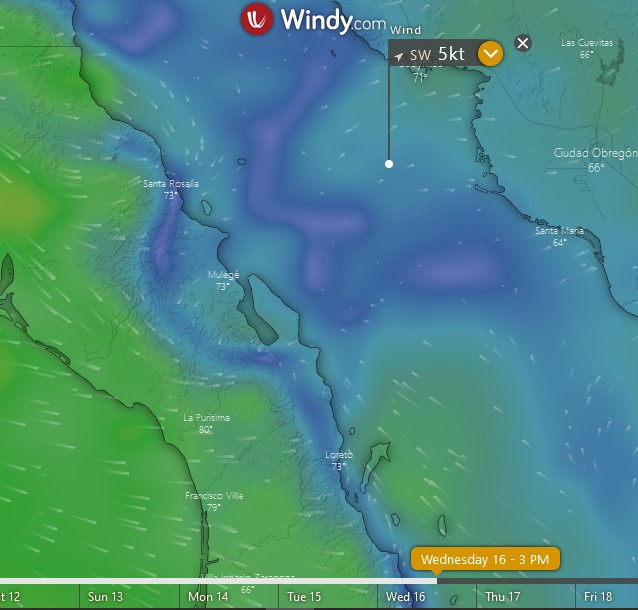
After consulting our neighbors who had been viewing WindyTY online, we decided it was best to head south in the morning before another two day norther arrived.  Monday, April 15 we left under power but had the sails up when the wind filled one hour later.  Wind and waves built as we sailed dead down wind, arriving four hours later off Isla Partida doing six knots in three foot seas.  Yahoo!
Anchored securely in the blue waters of Caleta Partida we let the norther build and blow, staying two nights.  Connie got the paddle board out and noodled around the shoreline.  I spent the day making lists and documenting things I want to remember next year. 


Night Crossing

 All winter long and into the spring the northers blow down the Sea of Cortez.  These wind events last a few days or a week, often following each other back to back so that the seas don't have time to calm.  The current norther has blown itself out and the wind had died.  But the seas are still high.  Consulting the wind and wave prediction models we see that the gap between this last norther and the next is only about 48 hours.

That's a problem because our window of opportunity is tight.  
We decide to wait 24 hours for the seas to calm, then to use the next 18 hours for our crossing, and have 6 hours (in the bank)just in case.   

In the bay at San Carlos, we waited until 4 PM then pulled up the anchor and motored out of the bay, heading directly south.  Our target: Isla Coronado.  The closest crossing from San Carlos is a shorter 13 hour run directly west to Punta Chivato.  But by adding 6 hours, we make our landfall 75 miles further south of Chivato, saving two or three days of sailing later. And with the next norther coming in, we will have to hide out for a couple of days somewhere.  

We knew that the southern anchorage of Isla Cornado will give us good protection from the strong north winds and the big seas that accompany them. The south anchorage looks north right at the tall volcanic peak that helps block the wind. We will be fine there for a few days.

  
Starlink Rocket Launch


An hour away from the San Carlos anchorage we found a one foot swell at four seconds from the northwest.  Now a one foot swell does not sound like much but when you are motoring in light to no winds, a swell off the stern quarter rocks the boat in an endless corkscrew manner making it difficult to eat, drink, use the head.
 
By sunset the northwest swell abated somewhat and a second, larger wave pattern approached from the southeast.  Now we had a corkscrew with a twist.  Connie took a three hour shift from six to nine.  I took a three hour shift from nine to midnight.  We raised the main with two reefs, thinking we might be able to sail but the wind shifted until it was right on the nose.  We kept the engine roaring along at 2000 RPM making about six knots directly south. The movement of the boat and the roar of the engine made sleeping mostly impossible.
      
Connie took over at midnight and I went below to toss and turn the rest of the night.  She's such a good night passage mate!  She can just keep going and keep going.  I came on deck at 5 AM to see the sliver of a moon rising in the east.  Connie hit the bed.  Soon the sun rose and we found ourselves dancing over the chop, wind on the nose, but making 6.5 knots over ground. To the west I could see the big nose of Punta Pulpito and the lovely bay of Caleta San Juanico.   As Isla Coronado approached we sat across from each other in the cockpit, bleary eyed and bone sore from bouncing around all night.  I'm thinking "I'm too old for this staying up all night stuff."

We made our way through a bevy of panga fishermen to the south side of the island and nosed toward the beach into 20 feet over sand and dropped 120 feet of anchor rode.  The wind continued from the south but we knew that soon, the norther would begin and we'd be facing land and the wind that was able to run across the island and its volcanic peak.  

 
Isla Coronado


Boom... I went down face first on the bed and slept until afternoon.  That evening, sure enough, the norther started right up and we could feel 20 to 25 knot gusts pushing Nepenthe from side to side.  However, with our nose only 200 feet off the beach, the waves were inconsequential.

Thus we sat for 48 hours resting, eating, writing, playing music, and getting snippits of cell coverage from the nearby town of Loreto.

We saw a turtle.  We saw pelicans diving for fish. We saw other boats taking refuge from the wind.  We saw a very large yacht come shelter alongside us with a half dozen crew in matching outfits.

Monday morning April 8 we'd had enough of the leisurely life so we headed south and transited the wide passage between Loreto and Isla Carmen, motoring slowly in the light southerly.  Just outside of Puerto Escondido a Lagoon 44 catamaran passed us and entered the harbor.  We made our way into the anchorage and marina complex and headed to the fuel dock where the Lagoon had arrived minutes before.  So we sat, we floated, we hovered, we waited.

   
Gas dock at Puerto Escondido


I cannot tell you how many times we've been passed on the way into a harbor, anchorage, or marina and see the other boat get the last spot or the one spot we were after.  All of a sudden it is a race.  Humans!

On the way into Puerto Escondido everything got a little quiet and I kept taking off my sunglasses wondering why I didn't really need them on this sunny morning.  It was 11:30 AM and the full solar eclipse was happening a hundred miles to our south.

After filling with 70 liters of diesel and 70 liters of water we were on our way, crossing over to Isla Danzante with the jib flying.  As we approached the Honeymoon Cove anchorage one boat came in from the north and another came in from the south and they both swarmed into the little anchorage.  There are only three spots in Honeymoon Cove.  There were two boats in there already so it looked like we were going to get skunked again.  However, those two boats must have been buddy-boating together because they popped right back out and headed south towards the larger anchorage at Los Candeleros.   We snagged the last tight little spot in the south lobe of the bay, dropping the anchor in 30 feet, running out 120 feet of chain and coming to a stop about 100 ft from rock walls on two sides.  Nice.


Our new CPT autopilot ran flawlessly the entire trip


Monday, May 20, 2024

Waiting out the wind, Waiting on the work


This one's from Connie: 


In the work yard sitting on the poop deck, Palo Verde blooming , birds, brown with creamy colored breasts and long tails are chattering away in the tree behind us, overlooking the sewage marsh. It's beautiful,really, until you know what's created it...Cranes and ducks visit, and little white ones, swallows, so many and I don't know what they are, but a birder would be in heaven, I think. With the Cerras las Tetas de Cabras in the distance, organ pipe cactus on the foot hills and tall grasses growing in the swampy water, it's quite verdant for the Sonoran desert. Two horses graze, lifting their heads to check you out.

It's coming up on the full moon and Semana Santa begins next week. Tomorrow, in fact, is Palm Sunday. I'm planning a trip to Rescate Market, a farmers and crafter's market with local food vendors that supports the Rescuers in the community of San Carlos. Then, I'll go to Santa Rosa grocery for carnitas and other sundry items to bolster our galley in hopes of getting to the other side...

There was a big wind event last night. Meg and Bob on SV Circe, our work yard neighbors, came over for after dinner tea and cookies. Shortly after they left for home the wind really kicked up gusting to 26kts, allegedly. You can hear it start way up in the mountains, a high pitched woo-ing followed by a mid range oh-ing and rushing down upon us with a full chested ah-ing. The whistling air compressed in the stainless steel tubing of Nepenthe and her surrounding boat buddies is a chorus of singing wind! It inspires me to create an Aeolian Harp in the rigging...maybe off the the back stay and attached to the brackets supports for the solar panels.

A brave little bird leaps into a gust of wind briefly, trying to stabilize itself, holding it's course and maybe finding a branch in a nearby tree. Larger birds revel in the ease of gliding, soaring higher to search out their next perch or prey, while here, poor Nepenthe sits on land, her wings bound, as we drill and sand her belly.

I'm here as moral supporter and filler of bellies, feeding body and soul with food and music, errand runner and provisioner. Maybe I'll put in some waypoints on the GPS. That way if we ever do get across to the Baja Peninsula we'll be ready to set a course. Ride this wind instead of hide from it!


Wednesday, March 9, 2022

Turn Around Time

The tide comes in, the tide goes out.  The La Paz anchorage is a half mile wide, three mile long, entrance to a much bigger lagoon.  Four feet of tide running in and out creates a two knot current running east or west, depending on if it is ebbing or flooding.   Add to this, a north wind and you've got an interesting anchoring situation where your boat will be facing into the wind but is also all the way forward on the anchor rode.  Wind across current makes an ever present chop.  

It's wise to bring up your anchor and reset every few days as the La Paz Waltz twists the anchor and rode around and around.  The rich oxygenated water helps the green slime build up fast on the rode so it is also beneficial to let out 30 feet for a few days, then bring it back in to let the sandy bottom clean the ground tackle.  It seems like a lot of boats have been here for a while given the shape of their sails, the growth on the hulls, and the white bird poop on the decks.  Sometimes those boats break loose and start to waltz around the anchorage, especially during a good northern blow. It's not the most peaceful anchorage you can imagine.

With our starter battery bank low, we needed to come into Marina de La Paz to get a good shoreside charge, and to top off the water tanks, provision, and get the part for the water pump ordered or machined.  I called into the marina and the front desk staff assured me they had no availability for the next week.  So I pulled the batteries out and took them ashore in the dinghy to get the local electric guy, Victor, to see if they could be resurrected.  After some shopping our friends told us that Neil, the marina manager, was trying to hail me on VHF 16.   I stopped in to see him and, sure enough, he had a slip for me.  

Nepenthe and White Raven, both crews are from Olympia WA

The boat's at anchor with no way to start the engine and no way to raise anchor with the windlass. But now there is a slip in the marina waiting.  What to do?  I went to a friend (who I just met) and asked if I could borrow his batteries... his only batteries.  Soon I was splashing my way out to Nepenthe with two big six volt batteries aboard.  We got them hooked up, started the engine, used the windlass and brought the boat into the dock,  where we removed the batteries, and put them back on my buddy's boat.  Thank you Cliff and Iris.

20 recreational pangas tie up at the marina
We spent four days in the marina and got our alternator and batteries sorted out.  I convinced Klassen Diesel in Vancouver BC to make me a new part for the raw water pump and they sent it off via international FedEx to Deko Importers in San Diego who sent it on to La Paz.  While waiting on shipping, we said goodbye to Noreen and Myron who caught their flight back to San Carlos and we washed the boat, inside and out.  Then we provisioned ( lots of wine ) and went back out to the anchorage and dropped the hook.  

Some of the days were so windy that we had to stay on the boat.  The dinghy ride to the dock would be a wet one. When the wind is up, the port is closed and all the dive, snorkel, and kayak pangas have to stay at the dock.  Occasionally a boat will come into the harbor during a wind event because "any port in a storm" is the rule.  But nobody exits during a closure.  Two sailboats limped into the anchorage after having a rough go of it in the 30 knot winds, 8 foot waves out beyond the harbor.  On had broken steering gear and engine trouble. Another had a broken prop shaft.  You really have to watch out for those strong northers and get into a hidey hole before you get stuck in big seas.

We found some shade fabric in town and started sewing a big awning cover to use in the summer when we put Nepenthe on the hard.  Connie played a little bit of music at the Club CucCruceros patio and also was the first act at Capuchino's open mic night.  


When our engine part was due to arrive,  I again went into the office to see if we could get a slip, and again, I was told by the front desk staff that there was no room.  Later, I talked to Neil and he arranged us a spot.  Funny how things work here sometimes. 

Part in hand, I compared it to the old part and behold.... they were not the same.  The new part was missing a feature that enabled it to straddle a big nut on the pulley wheel.   Dang!  Foiled again.

The service manager at Klassen Diesel suggested I take it to a local machine shop so I took it to Malcolm at Custom Fabrication and Machine and he put his machinist on the job.   

Old Part, New Part.  Note the difference.

Pulley nut sticks out a bit.

After the machine shop's magic.

Today I got the part back from the shop and Connie and I installed it without a hitch.  We tested it and all looks good.  Then we decided to treat ourselves to BBQ ribs in town.  Walking through the Restaurant / Banking / Shopping district we were blown away by how far La Paz had come in the eight years since we've been here.   Music on every corner.  Clean streets and sidewalks.  So many restaurants.  Art everywhere.  The Malecon was full of people roller skating, jogging, walking, biking.  Ice creme shops everywhere.  Clearly La Paz is a very cosmopolitan place these days.  

Tomorrow we have one more day of calm winds then three days of over 20 knot winds, followed by three days of calm wind.  Our plan is to run as far north as we can tomorrow, possibly to Isla San Francisco, lay low for three days, then run north again, hopefully getting into San Carlos by the 16th or 17th.

If it holds, this could be our crossing weather next week.


  And so we say goodbye to La Paz.  We stayed a bit too long but it's a wonderful city to be stuck in.


Sunday, February 27, 2022

Los Gatos to Isla San Francisco

As we headed south, each day was warmer than the next. Not only were we moving through winter and approaching spring but the latitude was decreasing every day.  Oh so nice to take off the socks.  On the morning of the 13th we rounded the corner out of Candelaros Chico and deployed for the first time our lightweight geniker sail, pleasantly surprised at how easy it was to hoist with its nylon sock.  Way to go, Nepenthe, give us something that actually works for once. 

Two hours later we doused the sail and motored toward shore near Isla San Cosme, anchoring in 25 feet on a sandy bottom and considerable swell coming down from the north.  Then all four of us piled into the dinghy and motored to shore to find a hot springs that Connie and I had visited eight years ago. 

How nice to be in bathing suits lying in a warm pool in the sun!
 

Three hours later we arrived in Agua Verde getting into a little race with another boat as they tried to beat us into the anchorage. Why does this always happen? Nepenthe won and claimed her spot.  Dropping the dinghy into the water, I paddled around and found some fishermen in a panga cutting up a Mahi Mahi.  When I asked if they had any more, one of the men showed me their fish well chock full of fish.  I motioned them to come visit our boat and soon thereafter we had two big slabs of meat aboard and the bony skeleton as well for Connie to make ceviche out of. 

Bahia Agua Verde faces north and gets the full impact of the swell.  We found that out the next day when we took the dinghy into town and had to execute a surf landing.  I tried to find a place where the surf was less challenging but the whole beach seemed like a mass of crashing foam.  Motoring back and forth just out of reach of the breaking waves, we looked behind us watching the size of the swells and finally after one big one, chose to begin the surf towards the beach.  As we got into shallow water, suddenly a big coamer crept up behind us, and slapped the flat stern of the dinghy, drenching the captain.  We rolled the boat ashore on its new dinghy wheels and set off to explore the village.

Two small tiendas in town provided us with fresh vegetables and fruit plus a chicken for the freezer.   Connie and I then braved the surf and ferried our purchases back out to Nepenthe as Myron and Noreen stayed ashore at Brisa Del Mar, a small thatched roof restaurant with WiFi.  Soon they were head down, noses into the cell phone, lost to Mexico and back in the information world, along with the other customers who were all doing the same.  Funny how when you are in cold wet Washington all you dream about is being at a sunny palapa restaurant with a cold beer in your hand, gazing out upon a white sandy beach without a care in the world.  That’s the challenge… letting go.

Coming back to the beach, the landing was straightforward, the food at Brisa Del Mar was good and everyone caught up on their email and WiFi needs.  By mid afternoon large breakers were crashing ashore on the flat beach as we rolled the dinghy into the surf.  Connie and Noreen got in and sat at the bow while Myron and I pushed from behind.  As waves hit the bow, the women were soaked as they both paddled furiously to get us off the shore.  “Get in.  Get in!” Myron jumped aboard, I did the same and put down the electric motor and punched it full throttle.  Just then a monster wave crashed into us, the bow rose up to meet the wave and in a waterfall of liquid we launched over the top and fell into the trough, then powered on out into deeper water where we shivered our way back to Nepenthe to find some dry clothes. 

Our boat was finally looking like a true Mexico cruising vessel.  The lifelines were full of salty, wet clothes and towels.  There was sand on the deck and cockpit and the gunnels smelled of fish.

The next day we sailed most of the way to Puerto Los Gatos then anchored and went ashore for an amazing time hiking around the red rock formations.   


Massive rocks at Los Gatos look like big fish laid out on the beach.

The next morning we prepped the boat and sailed her off the anchor in light winds that became strong westerlies soon thereafter, making it necessary to reduce sail.  To do so, we first turned downwind to blanket the jib with the main and were able to get it rolled up about halfway.  Then, back on a close reach, with the jib driving us to windward, we loosened the main sheet, tightened the topping lift, and let the main flog a bit as we tucked two reefs in the main, all without turning on the engine.  That went well.  Later, we rolled up the jib a little bit more as the winds built to 15 to 18 knots.  This was the most wind we’ve had Nepenthe in and she sailed well with a couple of scraps of sail.  Later, the wind moderated a bit and we were able to put more canvas up, arriving in San Evaristo at three PM after a successful 6 hour sail and 26 nautical miles.

Anchor down, dinghy in the water, electric motor mounted.  Noreen and Myron took the dinghy to shore to visit the tienda and a little restaurant.  By the time they returned it was dark and the wind was howling from the West, coming overland from the Pacific Ocean.  We sailed off the anchor again the next morning and entered the San Jose Canal between Isla San Jose and the Baja.  This area funnels the wind and waves from the north and can kick up quite a mess down around San Evaristo.  Soon we were bouncing up and down with a jib out halfway and no main but still maintaining over four knots speed.  Because of the sea state, we headed toward the sheltered anchorage of Isla San Francisco.  Connie took the wheel and in true Connie form, opted to run out the full genoa and soon we were galloping down the sea, pots and pans crashing below and everything in the cabinets tossing themselves back and forth. 

I left the crew to run the boat and laid down to read, every once in a while having to steady myself to keep from getting tossed onto the floor.  Sooner than we thought, we rounded the corner into the beautiful crescent bay on the south side of Isla San Francisco.   After dropping the hook in the northwest corner, we were shouted at by a loudspeaker on a big white catamaran, “ You are over our anchor.  I’ve got 200 feet of chain out.”   First of all, I thought we were more than 200 feet from that boat.  Second of all, why did he have 200 feet of chain out in 15 feet of water?  Oh well.  We brought the anchor up and moved closer to the beach before resetting.  


With lots of wind but no swell and little wave action, the anchorage was perfect for us to use to shelter in for the next few days as we waited out another period of strong north winds.  I clocked 20 knots of wind that afternoon while reading in the cockpit.  The National Geographic ship “Explorer” was in the bay and we watched her crew ferrying guests to and from the beach all day.  Everyone on our boat got to hike around to our heart’s content and, all in all, it was a very good two days.  


Salt Ponds

Friday, February 25, 2022

The Curse of Danzante Reef / Carnage at Caleta Candeleros Chico


San Juanico, what an amazing anchorage.   Two large monoliths of rock dominate the northern anchorage.  The eastern one is a succession of spires.  The western is a huge square block tilting a bit to the side, its top dotted with tall single cacti.  We call it the birthday cake because it looks like you pulled it out of the oven and one side fell a bit and stuck candles in it anyway...  Between these two monoliths is the sweet spot of the anchorage.  On shore are sandy beaches.  A catamaran can anchor in the shallow head of the bay near the beach.  Then between the monoliths is room for another boat or two in 20 feet of water and further out one or two more in 25 to 30.  Around the other side there is room for a half dozen more. 

The north anchorage at San Juanico is protected from waves and swell when the northerly wind is blowing down the Baja.  When the wind “out there” is blowing at 20 to 25 knots, the wind in the bay can be blowing at 15 to 20 knots as it runs across a low spot in the land.  In this part of the sea there is a hundred miles of fetch for the wind and waves to build as they head south.  Further down the coast, where there are more islands to break up the northerly wind and waves, the sea is calmer and the winds concentrate in the center of the sea and are lighter on the sides of the sea. 

We hope as we travel south and stay close to shore we will find relief from the strong northerlies.  In the meantime, we take care to move about in the morning when the wind is lighter and to make sure we have a solid set on the anchor with plenty of scope on the rode to keep our anchor from pulling free during the night.

Being the last boat to arrive, we were the ones furthest from the beach, anchored in about 25 feet on a sand bottom.  In the late afternoon, when driving the dinghy from the beach to the boat, the wind was up but the waves were tiny building to medium then building to about a foot when we finally reached the boat.  One minute all is calm then as we approach the boat, and turn upwind toward the boarding ladder, the waves start crashing over the bow of the dinghy and we get soaked trying to get aboard.  We quickly get the motor off the dinghy and haul the little boat aboard and the wind howls around us. 

Nepenthe yaws first to the starboard, showing her port side to the wind.  She comes up short on the anchor chain, heels over a bit, then shakes it off and points into the wind again only to fall off to port, showing her port side to the wind to come up short again.  In high winds, this goes on and on until the sun sets and the wind calms down. 

This area of the Sea of Cortez is constantly battered by the north wind in winter.  After looking at various wind models we decided that as soon as the winds moderate, we’d head south.  Meanwhile we were able to get to shore to do a couple of hikes, one north to the next bay and another inland to a little homestead with mules, goats, chickens, peacocks, and a turkey.  The family has some greenhouses out back and sells produce to people camping on the beach and boaters anchored in the Bahia.  


We decided to take the next calm(ish) morning and run south to Isla Coronados, 20 NM.  We were concerned that the engine was not starting easily and thought we had a fuel problem and sure enough, that morning we had to crank the engine for quite a while before it caught and ran.  Motoring out of the bay we soon ran into large swells coming down from the north but not much wind.  The strong winds that blew most of last week left the sea state quite confused.  With the boat tossing about, the headsail would not stay full so we ran under bare poles with the engine pushing us at about five knots.  At the western anchorage of Isla Coronados we saw the sailboat Krishelle at anchor and it seemed she was bucking about in the swell, so we proceeded through the channel around to the south side of the island and anchored a few hundred yards off the shore in about 25 feet of water with 150 feet of chain out.  


As the wind built, we took the dinghy ashore, pulled her up on the sandy beach, and started hiking towards the volcano.  After an hour and a half or so we had attained the ridge of a rocky spine within sight of the summit approach, the wind was howling.  We were leaning into it to keep our balance. Wow, these northers are strong.  I’m glad we anchored in the lee of the island.

Volcano doesn't look very high in this shot but it certainly is a long slog.


The fun factor falling quickly, Connie and I decided to backtrack.  Noreen and Myron pushed forward.  Back at the landing we found other cruisers in their dinghies and had some good conversations, nice to talk to people with much in common.   Later, Noreen showed up and soon after that, Myron arrived.  He’d made it to the top. She’d made it to the final scree slope.  Connie and I had made it to the top many years ago and had been there and done that.  I remember it was a long hot slog on that spring day back in 2013.

The next day the norther blew incessantly all day long so we stayed put. We had a good cell signal from Loreto so we downloaded the manual for the engine and read it thoroughly.  It mentioned that the pre heater (glow plugs) should be used in cool and cold temperatures.  I turned the ignition to the left to activate the heater and counted to five before trying to start it and, vualah! the engine cranked right up.  Back in San Carlos, when I asked Omar about using the preheater he said it was not necessary.  The manual said otherwise.  Could it be that we were not having fuel problems and that we merely needed more heat for the compression to ignite the fuel?


'That next morning was calm so we decided to hightail it south to Puerto Escondido.  With the preheat, the engine fired right up and off we went south down the wide channel between Loreto and Isla Carmen.  We tried flying the jib but again, the sea state would not cooperate and there was absolutely no wind.  The motor pushed us south at 6 knots.  Later the wind came up a little…. Right on the nose of course, from the south.  About four hours later we rounded the corner into Puerto Escondido, a natural harbor with a world class marina and four huge power yachts tied up at the big outer dock.  We found a yellow mooring ball, hooked it, and took the dinghy into the dock to pay the bill.  A dollar a foot for a mooring ball seemed a bit steep but hey, we’d been on the water now for a week without spending any money so why not?

On a mooring ball in Puerto Escondido


We were last here in May of 2014 on Traveler without a working engine.  Back then, Puerto Escondido was a sad and strange place with crumbling infrastructure and not much of a future.  See our blog entry from 8 years ago here….


But now… the upscale marina complex, now privately owned, has a small grocery store where we found fresh veggies and ordered a flat of eggs for the next day.  The rooftop café has good pizza and nice wine so we spent our pesos with the crème of society and felt pretty swell. 


The Tabor Canyon, (Steinbeck), a 3km walk from the marina was a nice diversion; an arroyo with large rocks that become boulders and eventually sheer walls requiring a short rope climb up to where the water would fall during summer monsoons into refreshing blue pools. Still, the shallow puddles remaining provide some water for an occasional dragonfly, and under the rocks you could hear the trickling sound of a once and soon to be again raging river. After walking the donkey tracks along the side of highway 12 back to the marina we had hot showers! Making use of the internet, Noreen and Myron found airline tickets to take them from LaPaz back to San Carlos at the end of the month.  On the morning of the 10th, we called ahead to the fuel dock to see if it was clear for us to come in.  Then we prepped the boat, let loose of the mooring ball, and powered in to take on diesel fuel and fresh potable water.  

The fuel attendant told us about the super yachts tied on the outer dock, the insane amount of fuel they take on, requiring the marina to bring in extra tanker trucks. The crew works for two weeks getting the yachts ready for the owner who may or may not show up soon.  The super yacht dock is specially built with power and fuel lines to service the massive ships.  Moonstone was one of the big yachts and it had a support vessel, Shadow, of almost the same size that was filled with jet skis, and smaller power vessels on deck with a massive crane to move them into the water.   The 20 person crew was working tirelessly getting the two ships ready for departure.  On the way out of the harbor we yelled over to one of the crew, “You should come with us.”  He replied, “I wish I could, “and turned back to his work scrubbing the deck and shining the chrome.

Dead flat water found us heading south again towards Caleta Candeleros Chico, a small cove only 10 NM south of Puerto Escondido. We passed by the larger Bahia Candeleros where back in 2014 we had to sail in after losing our engine navigating through Danzante Reef.  Back then, our rebuilt Perkins 4108 started making clunking noises as we approached the break in the reef;  these things happen at the most inopportune moments it seems.  The crankshaft was coming apart and that was the end of that engine...  That experience has left a scar on my psyche and now I fear this particular area of the Baja, thinking it will bring nothing but bad luck.

As for little Caleta Candeleros Chico,  Connie and I had been there many years ago and remembered it as feeling quite wild and quiet with lots of sea life.  We found our way into the tight entrance and anchored in a sandy bottom, having the place to ourselves.   Right away, the dinghy went into the water.  Right away the paddleboards were inflated.  Soon we were paddling around a rocky islet and seeing striped fish, sea urchins, and sea stars in the rocky shallows.  

I was rowing the dinghy around as Connie and Noreen had the paddle boards out for a spin.  As I came around the rocky corner I looked ahead and saw Noreen lying prone on the paddle board, her hat shading her face, floating in the clear blue water, in the sun.  Behind me, out on the point, Connie was also lying on her board, gently drifting into the cove.  Now, this is what we came here for.

Meanwhile, in the bottom of the refrigerator, the whole chicken we bought a week ago was getting stinky.   I came aboard, rummaged around and pulled her out, cut open the package and smelled the stink.  Overboard the chicken went.   Later, when we were pulling up the dinghy, the gang was peering into the clear water trying to make out what they were seeing lying on the sandy bottom.  It was our chicken, perched on the sandy bottom, waiting for the crabs; chicken of the sea…

Standing on the bow, I could look down into 20 foot of clear water and clearly see the anchor chain looping around the sandy bottom and the anchor itself with one of its flukes dug into the sand.   A group of striped fish lurked in the shadow of Nepenthe and a half dozen puffer fish were nosing the anchor chain.

Later, after dinner in the fading light, some pangas came into the bay and the bright orange and lime green clad fishermen hauled out big manta rays from the boat and tossed them on the beach where they cleaned them with machetes, tossing the center parts and guts into the water and the meaty wings into tubs before zooming off into the darkness. We later learned that these fishermen had caught turtles, manta rays, and hammerhead sharks in their nets and had come by this remote bay to process the catch out of sight of the authorities.  

Manta ray carcasses


The next morning the carcasses were exposed at low tide and the seagulls and turkey buzzards were having a feast.  The frigate birds swooped around stealing food from everyone while the pelicans dived for the little fish that were attracted to all the excitement.  The crew is all in agreement.  Despite the carnage, we like this place. I think we’ll stay here another day.


And we did. And we enjoyed another peaceful day. And the poachers came back at dusk with another 40 murdered manta rays and cut them up on the beach.


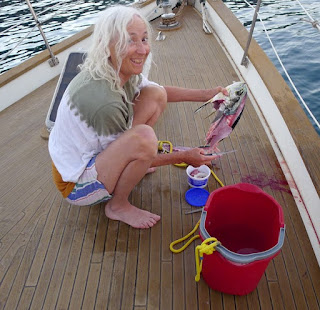
The next morning after an orange sunrise, Connie bought a fish off of an old guy and grandson in a panga.  We cleaned it on the beach then prepped the boat for departure. Myron took the wheel and Noreen pulled up the anchor and we headed out into deep water.  Connie popped her head up, “Something does not sound right down here.”

I looked into the engine compartment and saw a bit of water dripping from a raw water hose and below that, I could see the raw water pump on the front of the engine flopping side to side as if it was coming loose from where it is attached to the pulley and crankshaft. “Myron, turn the boat around. We’re going  back in to anchor.”  He turned the boat around and Connie went to the bow to get the anchor ready.  Slowly we crept back in and dropped the hook in 25 feet.  The curse of Danzante Reef had struck again!

All day long Myron and I worked on the raw water pump.  At first we thought the bracket was faulty so we re-engineered it to hold better.  After starting the engine we realized that the pump was still flopping around.  Then we took everything apart again and removed the impeller.  Then we attacked the four rusty bolts that held the coupler to the flywheel pulley and after copious amounts of WD-40 got those off to finally see the problem.  The coupler has a hole with a keyway that accepts the water pump shaft that has its own keyway.  That key was worn down and loose and had wallowed out the coupler keyway so the whole thing was a sloppy fit. We needed a new coupler and key. 

We found a spare key in a toolbox and cut it to size and filed it down to make it fit, reassembled the whole thing and started the engine.  In seconds, the water pump wallowed its way off the coupler.  Again, we disassembled everything. Connie pulled out the accordion, Noreen pulled out a book.  Myron and I set about re-engineering the bracket that holds the pump from rotating, we found a brass threaded plug and screwed it in then using seizing wire, wired the thing together to prevent the water pump from moving forward.  Then we took a clothes hanger, ( yes, a wire clothes hanger ) and secured the other side of the pump so there was no way that water pump could walk its way off that coupler. By that time it was happy hour so we tested our work and called it good for the day. Another night in paradise.


Rounding the corner at Candeleros Chico.  This rock is called "The hand of God".  See the hand?

The next morning we tested everything and decided that we’d just take it a day at a time and head south towards la Paz.  If our bailing wire solution would hold out for a week, then we’d be in la Paz where we could order a new coupler or maybe have one made at a local machine shop.  With trepidation we rounded the corner at Bahia Candeleros Chico and headed south towards Bahia Agua Verde.   Maybe, just maybe, the Curse of Danzante Reef was finally giving us a break.